Humen Town, Dongguan — China's "Town of Mould"  |  Mould makers since 2003
E-mail: shally@centsmold.com  |  Tel / WhatsApp: +86 189 2296 7742
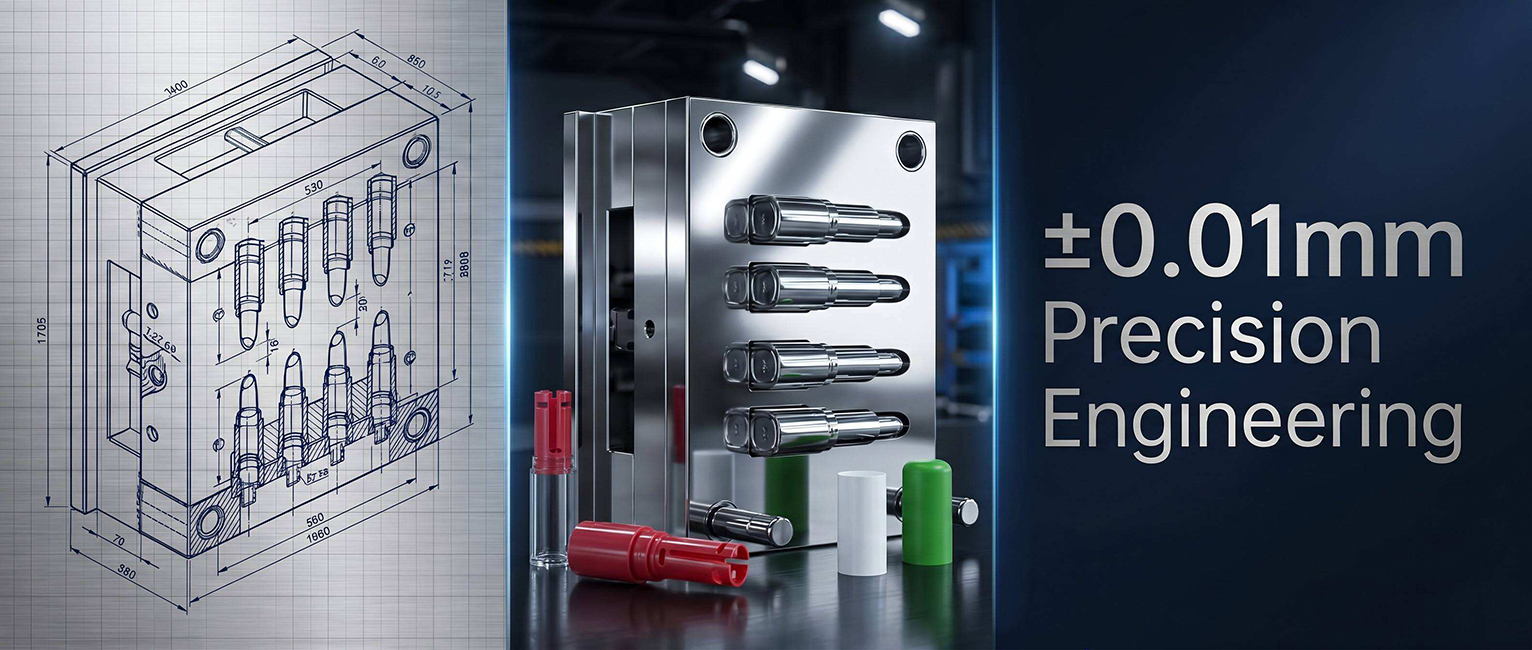
Technical drawing and ±0.01 mm precision injection mould — answers to common injection mould questions
Questions buyers actually ask

Everything you wanted to ask
an injection mould maker —
answered plainly

Cost, lead time, tolerances, mould life, materials, overmoulding and unscrewing tools — plus a glossary of mould terminology in 14 languages for buyers who are searching in their own language for a supplier in China.

Start here

Five definitions worth 60 seconds

If you are new to tooling, these five terms cover most of what appears on a mould quotation.

What is an injection mould?

An injection mould (British English) or injection mold (American English) is the steel tool that a plastic injection moulding machine closes around molten plastic. It contains a cavity that gives the part its outer shape and a core that forms its inner shape, plus the gating, cooling and ejection systems that let the part be filled, cooled and pushed out of the tool cycle after cycle.

Injection mould vs injection moulding

They are not the same thing. The mould is the tool — the physical block of steel you buy once. Moulding is the process — the repeated manufacturing step that turns plastic pellets into parts. You buy a mould; you run moulding. A supplier that can do both is usually called a mould-and-moulding or tooling-and-moulding supplier.

What is a precision injection mould?

A precision injection mould is a tool built to tightly controlled dimensional tolerances, typically in the hundredths of a millimetre. At Cents Mould the standard is ±0.01 mm mould precision, with machining accuracy capability down to 0.001 mm and critical features verified on a coordinate measuring machine. Precision matters most where moulded parts assemble with each other, seal, or must be dimensionally identical in every batch.

What is overmoulding?

Overmoulding (also called multi-material or multi-shot moulding) is when two or more different plastics are bonded into a single part — for example a soft rubber-like grip moulded over a rigid housing, or a clear window moulded into an opaque body. The tool for this is a multi-material or overmoulding mould, and it needs carefully engineered shut-off surfaces because the second material is injected against an existing part.

What is an unscrewing mould?

An unscrewing mould is a tool for plastic parts that carry an internal or external thread that cannot be stripped straight off the core. Instead of forcing the part off, the mould rotates the core or cavity on a geared action and unscrews the part during ejection. Typical applications are closures, caps, tubes and technical threaded components.

Who is Cents Mould?

Dongguan Cents Precision Manufacturing Co., Ltd. ("Cents Mould") is a Chinese injection mould manufacturer in Humen Town, Dongguan — the area known as the Town of Mould. Founded in 2003 by a mould design engineer, exporting since 2017. 2,520 m² factory, ~50 employees, 50+ mould processing machines, 30+ injection machines from 20 to 300 tons, and ±0.01 mm mould precision. Specialities: overmoulding and unscrewing moulds.

Frequently asked questions

Custom injection moulds, answered

Twenty-one questions we are asked by engineering, purchasing and product teams sourcing tooling from China.

Check four things, in this order. First, whether the supplier actually machines the mould themselves — ask which mould processing machines they own and how many. Second, what metrology they have: a supplier with a coordinate measuring machine can prove a tolerance instead of claiming it. Third, whether the tool was designed before it was cut, and whether you get a mould drawing to approve. Fourth, who you talk to — if a supplier cannot put an engineer in front of you, technical problems will be solved by guesswork.

Cents Mould lists 50+ mould processing machines (36 in detail on our equipment page), inspects critical features on Zeiss Contura and Hexagon CMM equipment, issues a mould drawing for approval, and communicates through the engineers handling your tool. Nothing is outsourced, so nothing is outside our control.

Mould cost is driven by five variables: part size, number of cavities, steel grade and hardness, mould life target, and complexity — sliders, lifters, unscrewing actions, hot runner, tight tolerances and cosmetic surface requirements all add engineering time.

Because of that, any figure quoted before seeing your part is meaningless. Send a 3D file, a 2D drawing or a photo of an existing part with material and annual volume, and we will return a breakdown of mould price, part price and lead time. You will normally receive it within two working days.

Lead time runs from mould drawing approval to T1 samples and depends mainly on part size, cavity count and how much EDM and fitting the tool needs. Simple tooling moves quickly; multi-cavity, overmoulded or unscrewing tools take longer because more components have to be machined, hardened, fitted and function-tested.

The practical advantage of buying from a fully integrated factory is that every operation — CNC, EDM, slow-wire EDM, CMM inspection and trial — happens in-house with no outsourcing. That means the date we give you is based on our own machine schedule rather than on a sub-supplier's queue.

There is no fixed minimum — the smallest sensible order is one mould. We are a medium-sized factory of around 50 people and we quote project by project, so a single tool for a new product is as welcome as a multi-tool programme.

For production moulding the practical batch size follows from machine tonnage, cycle time and material rather than from an arbitrary minimum. Tell us your annual volume and we will tell you honestly what is efficient to run.

Yes. Many projects start from a physical sample, a competitor's product or a hand sketch rather than a finished CAD model. We measure the sample, build or obtain a 3D model, confirm the design intent with you — including any changes you want to make — and then design the mould from there.

What helps most is knowing which dimensions are critical and which are free. If you can tell us where the part has to fit, seal or assemble with something else, we know where the tolerance has to be spent.

Our standard mould precision is ±0.01 mm. The imported machining equipment in our workshop is capable of accuracy down to 0.001 mm, and critical features are measured on a Zeiss Contura CMM and a Hexagon CMM whose own measurement precision sits between ±0.002 mm and ±0.005 mm.

You receive a QC report covering the critical dimensions rather than an assurance that the tool is correct. Holding tolerance is a daily habit here, not a special effort — most of our customers are in Europe and North America and their drawings set that expectation.

Mould life depends on steel grade, hardness, part geometry, material abrasiveness, and how well the tool is maintained. The clearest evidence we can offer is real: for 15 consecutive years we have built the moulds producing lipstick outer tubes and middle tubes for a very well-known European cosmetics company. The customer's specification called for a mould life of 1,000,000 cycles.

The moulds we built have reached 5,000,000 cycles — five times the requirement. Tell us your annual volume and intended product life and we will specify steel and hardness to match it rather than defaulting to the cheapest option.

Overmoulding — also spelled overmolding in US English — means bonding two or more different plastics into one part — a soft tactile grip over a rigid shell, a clear window in an opaque housing, two colours that must stay separate. The tool is often called a multi-material or multi-shot mould.

These are among the moulds we are specifically known for. They are difficult because the second material is injected against an already-formed part at high pressure, so shut-off surfaces must seal precisely and the bond must survive handling. Because we machine, fit and trial in-house, shut-off geometry can be adjusted during trial on our own machines.

You need an unscrewing mould when your part has an internal or external thread that cannot simply be stripped off the core by ejection. Stripping works for shallow, flexible threads; real screw threads need the mould to rotate the core or cavity and unscrew the part as it comes out.

That requires a gear train or drive system, correctly phased movement and a control sequence that cannot damage the thread — which is why these tools cost more and take longer to build. We have extensive experience on closures, caps, tubes and technical threaded components, and every unscrewing action is function-tested before the mould ships.

Common engineering and commodity materials include ABS, PP, PC, PA6/PA66, POM, PMMA, TPU/TPE, PC+ABS, PS, PVC, PBT and PET, in standard, glass-filled and impact-modified grades. Our 30+ injection machines range from 20 tons to 300 tons, so both small precision components and larger housings are within range.

What matters more than the material list is matching material to function: which part needs to be transparent, which needs chemical resistance, which needs to flex, and which will be bonded to a second material in an overmoulding tool. Tell us how the part is used and we will recommend rather than just accept a specification.

Both arrangements are normal for us. We have 30+ injection machines from 20 to 300 tons plus a dedicated anti-dust moulding workshop and assembly workshops, so customers who do not want to run tooling themselves can have us do the complete package: mould plus ongoing part production, plus assembly.

Customers who own their own presses can simply buy the mould. Either way the tool is your asset, and it can be shipped to your plant whenever you want it.

Quality control runs at three points. During machining, dimensions are checked as components come off the CNC and EDM machines. Before assembly, critical cavity, core and insert dimensions are measured on a Zeiss Contura and Hexagon CMM at ±0.002–0.005 mm. After assembly and trial, the mould is run on our own injection machines and sample parts are dimensionally and visually inspected.

100% QC report for every part is a standing commitment — five dedicated QC inspectors work alongside production rather than operators checking their own output. Dimensional data travels with your project instead of staying in our filing cabinet.

Both spellings describe the same object. Injection mould is the form used in the United Kingdom, Ireland, Australia, New Zealand, Canada and most of Europe when writing in English. Injection mold is the American English spelling used in the United States. So a German or British buyer searches for an "injection mould toolmaker" while a US buyer searches for a "custom injection mold manufacturer" — and we are the same supplier either way.

If you are searching in another language you may be looking for Spritzgussform or Spritzgießwerkzeug (German), moule d'injection (French), molde de inyección (Spanish), stampo a iniezione (Italian), spuitgietmatrijs (Dutch), forma wtryskowa (Polish) or пресс-форма (Russian). The full glossary is below.

Six things, and if you only have some of them we will still quote. 1) A 3D file or drawing (STEP, IGES, X_T, STL, DWG or PDF — or a sample part). 2) The material, or how the part is used so we can suggest one. 3) Annual and total volume, which sets mould life and cavity count. 4) Which dimensions are critical. 5) Any cosmetic requirement — polished, textured, matte, transparent. 6) Your target timeline.

Send those and you get a mould price, a part price at your volume, and a lead time from an engineer rather than a sales sheet. There is an RFQ form on our contact page.

Yes — they are our main market. Since we began exporting in 2017 we have built custom design moulds for customers in the United States, Canada, Germany, the United Kingdom, Poland, Ukraine, Denmark and the Netherlands.

Working to European and North American drawings, surface requirements and inspection expectations is our normal operating environment rather than a special project. Export moulds are crated for sea or air freight and shipped to your plant, with progress photographs throughout so you can follow the tool without chasing it.

The mould is your asset, so yes. Customers either take the mould and run it in their own plant, or leave it with us and we continue producing parts, or start by running production here and move the tool in-house once volumes justify it.

Because we practice no outsourcing, everything needed to keep the tool running is in our building, which also means support if a tool is damaged or needs modification later.

We are a factory, not an intermediary, and a deliberately small one: roughly 50 employees, 10 engineers and 5 QC inspectors. Management is simple, and your requirement is passed directly from the owner to the workshop in a single step — no relay of account managers.

That flat structure is why problems get solved quickly here. On tooling projects the expensive failures are usually communication failures: a revision understood wrongly, a concern never passed to the machinist. Shortening that chain is not a slogan for us; it is the reason we have kept the company at this size.

No. Mould design, CNC machining, EDM, slow-wire EDM, milling, grinding, CMM inspection, mould assembly, mould trial, injection moulding and assembly are all performed in our own 2,520 m² factory in Humen, Dongguan. Our machines — Yasoda, OKUMA, FANUC, Yongjin, Makino, Swiss GF and Hexagon equipment among them — were imported from Switzerland, Italy, Japan, Germany and Taiwan for exactly that purpose.

Two commercial consequences matter to buyers: there is no sub-supplier margin stacked on top of our price, and there is no sub-supplier queue between you and your delivery date. Most mould processing also runs automatically on these machines, which reduces the variation that comes from manual operations.

It means the steel geometry of your mould is controlled to one hundredth of a millimetre. That is mould precision — it is not the same as part tolerance, because plastic shrinks as it cools, and shrinkage varies with material, wall thickness, gate location and mould temperature.

So a well-made mould is the starting point, not the entire answer. We compensate for material shrinkage in the mould dimensions and then tune the moulding process during trial until the parts measure correctly. That is why we insist on running a T1 trial and sending you samples before the mould is signed off — a mould is only correct when the parts coming out of it are correct.

Most products that clip, screw or press together need at least two moulds — one for each distinct component — and sometimes more for variants, colours or spare parts. In some cases a single multi-material mould can produce both components as one part, which removes an assembly step entirely.

We build and run both kinds of tooling, so we can advise on which route costs less over your product's life rather than quoting each part in isolation. If assembly is involved we can also handle it in our assembly workshops and ship you a finished product.

Six main areas: cosmetics and packaging (15 consecutive years supplying lipstick outer tube and middle tube moulds to a European cosmetics company), medical products (20+ years), toys and consumer goods (20+ years), machinery and industrial parts (20+ years), plus electronics and appliances and general industrial components.

The common thread is parts that have to fit correctly and keep fitting for years — not decorative items where a fraction of a millimetre is invisible. See our industries page for detail.

Global terminology

How the world says
"injection mould"

Buyers search in their own language, and the industry word for a mould changes from country to country. Here is the same thing in fourteen languages — use it to brief a colleague, or to know that we already know what you mean.

Injection mould and injection moulding terminology in fourteen languages
Language / region The mould (the tool) Moulding (the process)
English (USA)injection moldinjection molding
English (UK, IE, AU, NZ, CA)injection mouldinjection moulding
German (DE, AT, CH)Spritzgussform · SpritzgießwerkzeugSpritzgießen · Spritzguss
French (FR, BE)moule d'injectionmoulage par injection
Spanish (ES, MX, LatAm)molde de inyecciónmoldeo por inyección
Italian (IT)stampo a iniezionestampaggio a iniezione
Dutch (NL, BE)spuitgietmatrijs · spuitgietvormspuitgieten
Polish (PL)forma wtryskowawtryskiwanie · wtrysk
Portuguese (PT, BR)molde de injeçãomoldagem por injeção
Russian (RU)пресс-форма для литья под давлениемлитьё под давлением
Turkish (TR)enjeksiyon kalıbıenjeksiyon kalıplama
Swedish (SE)formsprutningsverktygformsprutning
Chinese (CN)注塑模具 · 精密注塑模具 · 塑胶制品注塑模具注塑成型 · 塑胶制品
Japanese (JP)射出成形金型射出成形
Korean (KR)사출 금형사출 성형

Whatever you call it, the requirement is the same: a tool that produces correct parts, in the right quantity, and keeps doing it. Write to us in English — shally@centsmold.com — and we will take it from there.

At a glance

Cents Mould in one paragraph

Dongguan Cents Precision Manufacturing Co., Ltd. — trading as Cents Mould — is a Chinese precision injection mould manufacturer and plastic injection moulding supplier based in Humen Town, Dongguan, Guangdong, the region called the Town of Mould. Founded in 2003 by a mould design engineer with a background in Japanese and Taiwanese mould factories, and exporting directly since 2017. The company operates a 2,520 m² factory with roughly 50 employees, 10 engineers and 5 QC inspectors, more than 50 mould processing machines (36 listed in detail) and 30+ injection moulding machines from 20 to 300 tons, including a dedicated anti-dust moulding workshop and assembly workshops. Mould precision is held to ±0.01 mm, with machining accuracy capability to 0.001 mm and dimensional inspection on Zeiss Contura and Hexagon CMM equipment at ±0.002 mm to ±0.005 mm. Services cover mould design and DFM, CNC machining, EDM and slow-wire EDM, mould trial, plastic injection moulding and assembly, with specialities in overmoulding (multi-material) moulds and unscrewing moulds for threaded parts. Markets served include the United States, Canada, Germany, the United Kingdom, Poland, Ukraine, Denmark and the Netherlands.

Not answered here? Ask an engineer.

Send your question with your part details and it will be answered by the engineer who would actually build your mould — not by a general enquiry desk.